Project Endgame
Systema Delenda EstProject Endgame is Cato’s final commitment to destroying the System rather than merely resisting its agents or severing individual worlds. Conceived as a distributed assault on the Core, it transforms decades of industrial growth across the Inner Worlds into twenty-four stellar-scale weapons. Its firing destroys the Core, annihilates the largest weapons ever built, and brings the campaign against the System to its decisive conclusion, while leaving Cato fully aware that the victory will kill millions and reshape entire regions of space.
Conception and Irreversibility
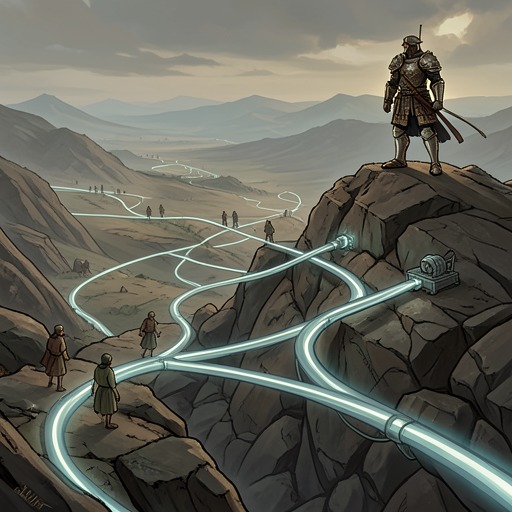
Project Endgame begins as a brief command rather than a public declaration. Cato sends the message to selected versions of himself stationed in the Inner Worlds: “Project Endgame.” Twenty-four transceivers on worlds physically closest to the Core accept it and transmit their payloads toward stars that have recently gone dim. The operation is deliberately distributed, because Cato still has no way to infiltrate the Core or communicate directly with those within it. The message will take years to produce its final effect through lightspeed delay, and once transmitted it cannot be recalled.
The timing reflects both preparation and desperation. Cato is waiting for more Alums to leave the Core, and none are being sent to Heimdall for digitization, but he recognizes that even Heimdall will eventually become unreachable. Project Endgame therefore marks the point at which postponement becomes impossible: he retains years for further measures, yet understands that those will be last efforts rather than alternatives to the plan. The operation is not a sudden improvisation but the irreversible activation of infrastructure planted long before the final confrontation.
The Nicoll-Dyson Assault
The weapon deployed by Project Endgame is the Nicoll-Dyson Beam Parry This You Filthy Casual, one of multiple versions built around suitable stars. A Nicoll-Dyson beam surrounds a star with mirrors and redirects its light toward a distant target. It is not a laser, but the distinction is immaterial at this scale: the output of an entire star is focused on a single point, producing more destructive power than Cato could obtain from fusion bombs or particle beams.
Cato has seeded twenty-four versions of himself around stars with sufficient luminosity, using Inner Worlds close to the Core as launch points. The dense concentration of stars in the Large Magellanic Cloud provides candidates only a few light-years away. Each installation spends nearly eighty years building manufacturing infrastructure; only during the final two or three years do the stations concentrate on producing the mirror swarms. The arrangement is therefore an industrial project as much as a weapon. Its components are based on familiar commercial technology: satellites use photon pressure to balance gravity instead of relying on conventional orbits, while archived knowledge from Cato’s father supplies the modifications needed to turn ordinary designs into an apparatus of unprecedented scale.
The system is not perfectly complete when the attack begins, but it is operational. Mirror replacement is already part of routine maintenance in the volatile environment near a star, and the beam is not limited to a single discharge. Once focused, it can continue for as long as the star itself lasts, creating a permanent destructive force aimed at the Core. Twenty-four beams coordinate across light-years against a target less than a million miles wide, making Project Endgame a distributed act of precision violence rather than a single explosive strike.
Firing and Immediate Destruction
The final firing takes place from a control center built into a minor planet. Cato-Aleph announces that the target is in time, while the tactical display shows every installation, its completion percentage, and its timing data. Cato, Raine, and Leese make their final preparations to transmit out. Signals take minutes to travel from the control center to the mirror swarms and return, and the viewscreen shows the stars dimming as their light is redirected toward the Core. Then Cato gives the final order: “Fire.”
The result is visible through Misse’s scry-view as the entire Core catches fire. The attack is far beyond ordinary combustion: air becomes glowing, white-hot plasma, every surface across the Core is affected, planets seem to become suns, and even the True Core shines through the reflected violence. High-rank materials and individuals can resist, but doing so consumes essence, causing the System’s total reserves to fall for the first time since Misse severed the frontier.
The assault also produces a dangerous systemic reaction. When Misse and Muar restrict the System’s influence and force it to pull back toward the True Core, ordinary physics resumes around the War Worlds. A hundred suns that had been held in place find themselves practically touching, and gravity reasserts itself. The apparent stabilization is deceptive: essence totals continue falling at extreme speed, as though the weapon contains a further trigger that activates in response to the System’s attempted defense.
Consequences and End of the Campaign
Project Endgame ultimately creates a black hole almost directly atop the True Core. Its gravity seizes the System’s anchor and removes it from the universe behind an impossible well that ordinary physics cannot cross. The remaining Core worlds and works explode outward as high-energy dust, material that will become a nebula over thousands of years. The destruction is therefore both military defeat and cosmic transformation: the institutional center of the System disappears, while its former territory becomes the seed of a radically altered astronomical future.
The blast front expands across light-years, but Cato has anticipated the possibility. Versions of himself near the Core shelter their servers in deeply bunkered facilities protected by layers of ablative shielding. Farther worlds use enormous umbrella-like structures to reduce the radiation and near-lightspeed plasma to auroras and brilliant nights. The precautions preserve portions of Cato’s distributed population, but they do not spare the weapon itself. The shockwave shreds the fragile mirror swarms, destroying the largest weapons humanity has ever built after they have fulfilled their purpose.
The moral cost remains explicit. Cato knows that the attack will kill thousands, millions, or perhaps more, and that those deaths will be his responsibility. He nevertheless treats continued System expansion as the greater catastrophe: left intact, the System would continue murdering billions and reducing civilizations to an undifferentiated mass. Project Endgame thus completes the book’s central conflict between liberation and collateral destruction. Cato’s campaign is finished not because violence has become clean, but because he has chosen an irreversible violence that he believes is the only remaining means of ending the System’s power.